Odds and Ends

Some topics just don't fit neatly into one category or another, some topics are related to many other items.
I Ching (Yijing): Consulting the Sage
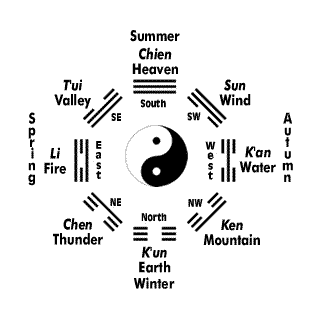
The I Ching, or Book of Changes, is one of the oldest Chinese classics, traditionally dated to the early Zhou dynasty (c. 1000 BCE), with mythic origins attributed to the culture hero Fuxi. Over centuries it evolved from a divination manual into a foundational philosophical text within both Confucianism and Daoism. The book is structured around 64 hexagrams—figures composed of six broken or unbroken lines—each representing a pattern of change. At its core, the I Ching teaches that reality is dynamic, cyclical, and governed by the interplay of yin and yang.
Historically, the I Ching has been used for fortune telling through the casting of yarrow stalks or coins to generate a hexagram. The resulting figure is then interpreted through the accompanying judgments and line statements. Yet its “fortune telling” function is less about predicting fixed outcomes and more about illuminating present conditions and the tendencies inherent within them. It offers symbolic guidance, encouraging reflection, ethical awareness, and alignment with the natural flow of events. Rather than foretelling destiny, it invites participation in the process of change.
This reflective quality parallels a practice found in Stoic philosophy. Roman Stoics such as Epictetus and Marcus Aurelius advised students to “consult the sage” when faced with uncertainty—asking what a wise and virtuous person would perceive or do. In this sense, the I Ching can function as that sage. When one casts a hexagram, one is not surrendering agency to fate but engaging in dialogue with a symbolic embodiment of wisdom. The text’s archetypal images—of thunder, wind, mountain, and water—speak to universal patterns in human behavior and nature, helping the reader step back from emotion and respond with clarity.
The eight trigrams, or ba gua, form the building blocks of the hexagrams and represent fundamental forces of heaven, earth, water, fire, thunder, wind, mountain, and lake. These trigrams are deeply embedded in Chinese martial arts and internal practices such as tai chi (taijiquan). Systems like Baguazhang explicitly organize movement around the eight trigrams, while tai chi expresses the dynamic alternation of yin and yang described in the I Ching. Practitioners study these patterns not merely as symbols but as embodied principles—learning to adapt, yield, advance, and transform according to circumstance.
For many students, long engagement with the I Ching cultivates a profound sensitivity to cycles of growth and decline, advance and retreat. By internalizing its model of change, one begins to see recurring patterns in politics, relationships, health, and personal development. The claim is not omniscience, but preparedness: when one understands that all situations contain the seed of their opposite and that transformation is constant, nothing that happens is entirely shocking. In this way, the I Ching becomes both mirror and mentor—revealing the structure of the universe through the rhythms of human life.
Recommended Reading
- The Complete I Ching – 10th Anniversary Edition: The Definitive Translation by Taoist Master Alfred Huang — a modern, comprehensive translation with historical and practical commentary on the I Ching and its usages.
- I Ching, the Oracle: A Practical Guide to the Book of Changes by Benebell Wen — recent annotated translation with cultural and divination explanations.